Concrete is tough, reliable, and built to last. Yet even the strongest concrete eventually develops cracks. Some are harmless surface cracks. Others can allow water, chemicals, and moisture to move deeper into the structure, creating bigger problems over time. This is why choosing top notch construction materials remains essential.
That brings us to an interesting question: Can concrete actually repair itself?
The short answer is yes, in certain situations.
Self-healing concrete is an emerging construction technology designed to repair or seal cracks without traditional manual intervention. Researchers and manufacturers are exploring several approaches, including bacteria, mineral-based agents, polymers, capsules, and chemical compounds that activate when cracks form.
It sounds like something from the future, but the science is already here.
For contractors, builders, property owners, and developers, however, there is another question worth asking: Does self-healing concrete make sense for my project?
The answer depends on the application, environmental conditions, project budget, expected service life, and the quality of the construction materials used from the start.
At Kraken Crushed, we understand that good construction starts with good material decisions. Whether a project involves foundations, driveways, commercial structures, roads, drainage work, or large-scale site development, choosing dependable materials can have a major impact on long-term performance.
What Exactly Is Self-Healing Concrete?
Self-healing concrete is concrete engineered with materials or mechanisms that can respond to cracking and help seal or repair the damaged area.
Traditional concrete does not have a biological or chemical system designed to repair cracks. Once a significant crack develops, repairs generally require inspection, sealing, patching, injection, resurfacing, or other maintenance methods.
Self-healing concrete takes a different approach.
The concrete contains a healing mechanism that becomes active when cracking occurs. Depending on the technology, that mechanism may produce minerals, release a sealing agent, trigger a chemical reaction, or encourage further hydration.
The goal is not necessarily to make a large structural crack disappear completely. Instead, many self-healing systems are designed to close small cracks and reduce pathways through which water and other damaging substances can enter.
That distinction matters.
Self-healing concrete is not a magic solution for every concrete failure. It is a specialised material technology that can potentially improve durability when used in the right conditions.
How Does Concrete Repair Its Own Cracks?
There is more than one method.
1. Bacteria-Based Self-Healing
One of the most talked-about approaches involves bacteria.
Certain bacteria can remain dormant inside concrete for long periods. When cracking allows water to enter, the bacteria become active and produce minerals such as calcium carbonate.
Those minerals can gradually fill small cracks.
The concept is fascinating because the bacteria essentially remain inactive until the environmental conditions allow them to function.
2. Encapsulated Healing Agents
Another approach involves placing tiny capsules containing healing substances inside the concrete.
When a crack reaches a capsule, it can rupture and release the material. That substance then reacts or hardens, helping seal the crack.
This method can be designed around specific concrete applications and desired performance characteristics.
3. Autogenous Healing
Interestingly, concrete already has a limited ability to heal some small cracks naturally.
This is known as autogenous healing.
Unhydrated cement particles can continue reacting with water after the concrete has hardened. Certain chemical reactions can also produce materials that help close very small cracks.
However, natural self-healing has limitations. It works best with relatively small cracks and favourable moisture conditions.
4. Chemical and Polymer-Based Systems
Some self-healing technologies use polymers, minerals, crystalline materials, or other chemical systems that react when cracks develop.
These technologies continue to evolve, and different products are designed for different construction environments.
For buyers and contractors, the takeaway is simple: not every self-healing concrete product works in the same way.
Does Self-Healing Concrete Really Work?
Yes, but expectations need to be realistic.
Research has demonstrated that various self-healing concrete technologies can reduce crack widths and improve resistance to water penetration under suitable conditions.
The strongest applications are generally associated with small cracks rather than major structural damage.
Think of it this way.
If a concrete surface develops a fine crack, a self-healing mechanism may help seal that pathway. If a foundation has experienced serious structural movement and developed a large crack, self-healing concrete should not be considered a replacement for professional inspection and structural repair.
The technology is best viewed as an additional durability strategy, not a substitute for sound engineering.
And that brings us back to something every contractor already knows: the quality of the original construction still matters.
Why Material Quality Still Matters
It is easy to get excited about new construction technology and overlook the basics.
Concrete performance begins with the fundamentals.
The mix design, aggregate quality, cementitious materials, water content, placement, compaction, curing, reinforcement, environmental conditions, and workmanship all influence the finished product.
Even advanced concrete technology cannot compensate for poor construction practices.
High-quality aggregates provide the foundation for consistent concrete performance. Properly selected materials can contribute to strength, workability, durability, and predictable results.
For a contractor, the objective is not simply to find the newest material on the market. It is to find materials that make sense for the project.
Where Could Self-Healing Concrete Be Useful?
Self-healing concrete could be particularly interesting for projects where crack control, durability, and reduced maintenance are important.
Potential applications include:
- Bridges and transportation infrastructure
- Underground structures
- Water-retaining structures
- Tunnels
- Parking structures
- Foundations
- Roads and pavements
- Commercial buildings
- Industrial facilities
- Marine structures
- Infrastructure exposed to moisture
Consider a structure that is difficult or expensive to access.
If small cracks can be sealed automatically, even partially, that could reduce the frequency of certain maintenance activities and help limit water penetration.
For infrastructure owners, that could become a meaningful financial advantage over the life of a structure.
Is Self-Healing Concrete More Expensive?
In many cases, advanced self-healing concrete technologies can cost more upfront than conventional concrete.
That may make some contractors hesitate.
But construction costs should not always be judged only by the initial purchase price.
There is a difference between cheap and cost-effective.
A material that costs less today but requires frequent maintenance may ultimately become more expensive than a higher-performing material with a longer service life.
This is where lifecycle thinking becomes important.
If a specialised concrete solution reduces maintenance requirements, protects reinforcement from moisture-related deterioration, or extends the useful life of a structure, the additional upfront cost may be easier to justify.
Still, every project is different. Engineers and contractors should evaluate the expected performance, installation requirements, material availability, and total project economics before making a decision.
What About Conventional Concrete?
Self-healing technology does not mean traditional concrete has become obsolete.
Far from it.
Conventional concrete remains one of the most widely used construction materials because it offers a strong combination of availability, versatility, performance, and cost.
For many projects, the most sensible strategy is still to use a well-designed conventional concrete mix supported by quality aggregates and proper construction practices.
The real opportunity is knowing when an advanced material provides enough additional value to justify its use.
That decision should be based on the project, not hype.
The Importance of Reliable Material Supply
Imagine scheduling a concrete pour and discovering that the required aggregate or other construction material is delayed.
Your crew is ready. Equipment is booked. The site is prepared. The schedule is tight.
Now the entire project is waiting on material.
Reliable supply matters just as much as material quality.
That is why contractors often look for a dependable construction material company in Michigan that understands local project requirements and can provide materials when they are needed.
A strong supplier should be able to communicate clearly, understand quantities, support project schedules, and provide consistent materials.
For contractors working across Michigan, dependable construction materials Supply in Michigan can help keep projects moving and reduce unnecessary scheduling headaches.
Why On-Site Material Service Can Make a Difference
Large construction projects are not always located conveniently next to a material supplier.
Transporting heavy materials over long distances can increase costs and complicate scheduling.
An On-Site Construction Materials service can offer a practical alternative for projects that require materials delivered directly where the work is happening.
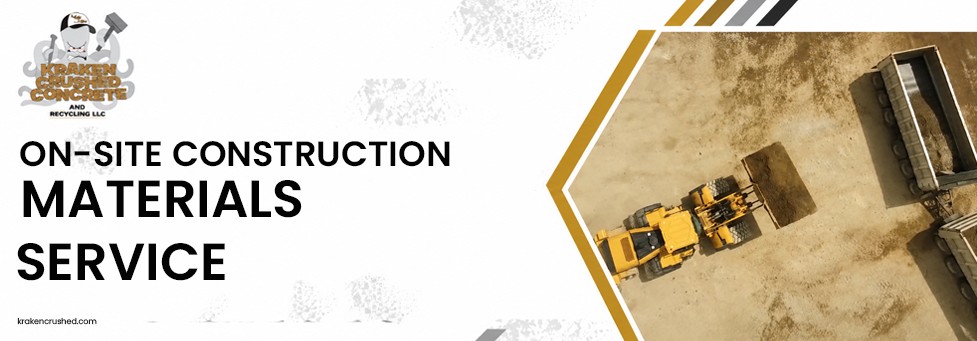
This can be particularly useful for excavation, road construction, landscaping, site development, commercial construction, and other projects where substantial quantities of aggregate and related materials are required.
When materials arrive at the right location at the right time, crews can spend less time waiting and more time working.
That is a small operational advantage that can have a big impact on a project schedule.
What Should Contractors Look For in Construction Materials?
Before ordering any material, ask a few straightforward questions.
Is the material suitable for the application?
A material that performs well for one project may not be appropriate for another.
Is the quality consistent?
Consistency matters when contractors need predictable results across large quantities.
Can the supplier meet the required volume?
A project can quickly become complicated when supply does not match demand.
Is delivery reliable?
A material sitting at the wrong location is not particularly useful to a busy construction crew.
Does the supplier understand construction requirements?
Experience matters. A supplier familiar with contractor needs can often make the ordering and delivery process much smoother.
Could Self-Healing Concrete Become Mainstream?
It is possible.
As construction moves toward longer-lasting infrastructure, reduced maintenance, and more sustainable building practices, materials that can improve durability will continue to attract attention.
The technology still has challenges to overcome. Cost, scalability, long-term field performance, production methods, environmental conditions, and standardisation all matter.
But the concept has genuine potential.
The biggest opportunity may not be replacing conventional concrete everywhere. Instead, self-healing technology could become increasingly valuable in specific applications where crack control and durability have a particularly high economic impact.
The Bigger Lesson for Builders
Self-healing concrete is exciting because it represents a shift in how we think about construction materials.
For decades, the focus was largely on making materials stronger.
Now the conversation is expanding.
Can materials last longer? Can they respond to damage? Can they reduce maintenance? Can they use fewer resources over their lifetime?
Those are important questions for the future of construction.
Yet advanced technology should always be supported by strong fundamentals.
Quality aggregates. Proper mix design. Good site preparation. Correct placement. Appropriate curing. Experienced contractors. Reliable supply.
Put those pieces together and you have a much stronger foundation for successful construction.
Choose Materials With the Project in Mind
The future of construction will likely include smarter and more specialised materials. Self-healing concrete is one of the most interesting examples, and its potential to reduce cracking and maintenance deserves attention.
But today’s projects still depend heavily on dependable materials and reliable supply.
At Kraken Crushed, the focus is on helping contractors and project teams access quality construction materials for demanding applications. Whether you need aggregate for a new construction project, roadwork, site development, landscaping, or another application, choosing the right material and supplier can make the entire process easier.
If you are evaluating top notch construction materials for your next project, do not look only at the price per load. Look at material quality, consistency, availability, delivery, and the value the supplier brings to your project.
Because when construction materials are right from the beginning, everything built on top of them has a better chance of performing the way it should.
Frequently Asked Questions
- Is self-healing concrete actually real?
Yes. Several self-healing concrete technologies have been researched and tested. Depending on the system, bacteria, capsules, minerals, polymers, or natural cement hydration can help seal small cracks.
- Can self-healing concrete repair large structural cracks?
Generally, no. Self-healing systems are primarily intended to address smaller cracks. Significant structural cracks require professional evaluation and appropriate repair.
- Is self-healing concrete better than traditional concrete?
Not necessarily for every project. Self-healing concrete can offer advantages in applications where durability and reduced maintenance are priorities, but conventional concrete remains highly effective for many construction projects.
- Does self-healing concrete cost more?
Specialised self-healing technologies can have a higher initial cost. However, potential reductions in maintenance and improved durability may make them worthwhile for certain projects.
- Where can contractors find reliable construction materials in Michigan?
Contractors should work with an experienced supplier that can provide consistent materials, suitable quantities, dependable delivery, and support for their specific project requirements.