A house can be impressive when it is finished. But for builders and contractors, the real measure of a successful project begins long before the final coat of paint. It starts with the decisions made during construction.Imagine handing over a beautiful new home to a family that plans to live there for decades. Now imagine knowing that the same home was built with materials selected to reduce waste, improve resource efficiency, and support a healthier environment. That is where eco-friendly construction materials become more than a design preference.
Sustainable building is becoming an increasingly practical choice for modern construction projects. Homeowners are asking better questions about where materials come from, how long they will last, and what happens when they eventually need replacement.
For builders, this creates an opportunity to rethink conventional choices without compromising structural performance. At Kraken-Crushed-Concrete, we understand that responsible construction still needs dependable materials, consistent quality, and practical solutions that work on real job sites.
So, how can you build homes that respect both the people living inside them and the environment outside?
Let’s explore.
A Sustainable Home Starts with Better Material Decisions
Every construction project tells a story.
It begins with a site, a plan, a budget, and a long list of materials. Concrete, aggregates, blocks, timber, insulation, finishes, and countless other components eventually come together to create something that may stand for generations.
However, every material choice also has consequences.
Where was it sourced? How much energy was required to produce it? Can it withstand the demands of the project? Can it be reused or recycled later?
These questions are becoming increasingly relevant for today’s construction professionals.
Sustainability does not mean choosing the cheapest or most environmentally friendly-looking product. It means finding the right balance between performance, longevity, resource efficiency, and environmental responsibility.
That mindset, with quality eco-friendly construction materials, can influence everything from the foundation to the driveway.
What Makes A Construction Material More Sustainable?
The term “eco-friendly” can mean different things depending on the material and application.
For builders and contractors, sustainability should be assessed practically rather than emotionally. A material may contribute to a greener project when it has characteristics such as:
- Recycled or recovered content
- Long service life
- Efficient transportation requirements
- Lower material waste
- Reusability or recyclability
- Responsible sourcing
- Strong performance that reduces replacement needs
Durability deserves particular attention.
A material that lasts longer may reduce the need for repairs, replacement, transportation, and additional manufacturing. Therefore, sustainability is not simply about what happens when a product is manufactured.
It is also about what happens throughout its useful life.
Recycled Aggregates Can Give Construction Waste Another Purpose
Construction and demolition generate enormous quantities of material waste. Concrete, bricks, asphalt, and other aggregates can often be processed rather than immediately sent to landfill. Recovered materials can then find new applications in suitable construction projects.
This is where recycled aggregate becomes particularly interesting. Instead of treating every demolished structure as waste, contractors can view certain materials as another resource waiting for its next application.
Crushed concrete, for example, can be processed into usable aggregate for appropriate construction and civil engineering applications. For contractors, this approach can support material efficiency while reducing dependence on newly extracted aggregate.
Of course, suitability depends on the project specification, material quality, and intended application. Good sustainability still begins with good engineering judgment.
Choosing Eco-Friendly Construction Materials Without Compromising Performance
Sustainability should never mean sacrificing performance.
A home still needs a reliable foundation. Roads still need stable bases. Drainage systems still need appropriate materials. Structural applications still require products that meet the relevant specifications.
That is why eco-friendly construction materials should be evaluated using the same professional standards as conventional alternatives.
Ask practical questions before ordering:
- Does the material meet the project’s requirements?
- Is its quality consistent?
- Is it suitable for the intended application?
- Can the supplier provide relevant documentation?
- How will transportation affect the overall project?
- Can excess material be reused elsewhere?
This approach prevents sustainability from becoming a marketing exercise. Instead, it turns environmental responsibility into part of sound construction planning.
What’s The Role of Sustainable Construction Materials in Modern Homes?
Home construction has changed considerably.
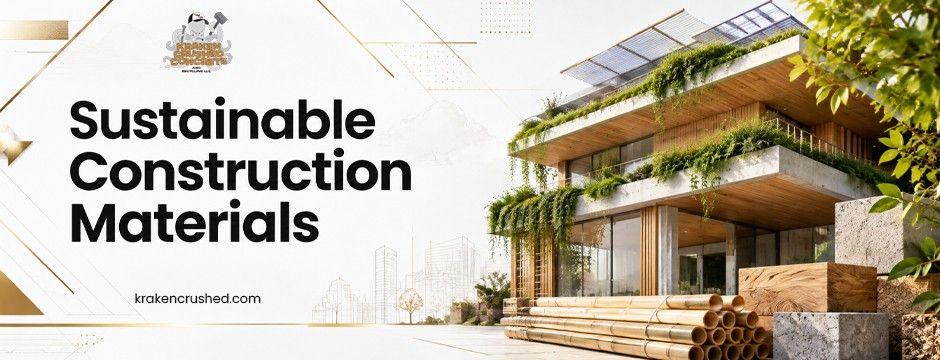
Today’s homeowners often think beyond floor plans and finishes. They may ask about energy efficiency, insulation, water consumption, indoor air quality, and material sourcing. That shift creates demand for sustainable construction materials that support broader environmental goals.
However, sustainability works best when it is considered as a complete system.
For example, selecting efficient insulation can reduce energy demand. Durable exterior materials can reduce maintenance requirements. Recycled aggregates can help divert suitable construction materials from disposal.
None of these decisions exists independently. So, when combined thoughtfully, they can contribute to a home designed around efficiency, durability, and responsible resource use.
Think about The Entire Life Cycle of The Home
One of the easiest mistakes is focusing only on the construction stage. A sustainable home should be considered across its entire life cycle. Construction is only the beginning. The building will eventually require maintenance, repairs, upgrades, and perhaps renovation. Material durability therefore becomes incredibly important.
Suppose two materials perform similarly at installation. One requires frequent replacement while the other remains effective for many years. The second option may provide a stronger sustainability advantage over time, even if its initial cost is higher.
This is why experienced contractors look beyond the purchase price. The better question is often: “What value will this material deliver over the life of the project?”
House Construction Materials Should Be Chosen With The Future in Mind
When selecting house construction materials, it is tempting to focus exclusively on immediate availability and cost. Those factors certainly matter. Construction schedules cannot afford unnecessary delays.
However, future performance deserves equal attention. A material should ideally support the home’s intended lifespan while remaining practical for maintenance and future renovation. Contractors can also discuss material choices with homeowners early in the planning process. This helps align environmental priorities with technical requirements and budget expectations.
The result is a more considered project from the beginning. After all, sustainability is much easier to build into a house than to retrofit later.
Sustainability Can Begin with The Ground Beneath The House
When people imagine sustainable homes, they often picture solar panels, green roofs, or energy-efficient windows. Those features certainly have their place, but sustainability can begin much earlier. It can start with the aggregate beneath a foundation, driveway, access road, or landscaping area.
Hence, choosing suitable recycled eco-friendly construction materials for applicable non-structural or civil works can help reduce reliance on virgin resources. For contractors managing multiple projects, these decisions can become part of a broader sustainable construction strategy.
Here, the lesson is simple: environmental responsibility does not always require a dramatic change. Sometimes, it begins with making a smarter choice about something as ordinary as aggregate.
Building Sustainably Is Also about Building to Last
There is an important connection between sustainability and durability. A home that requires constant repairs consumes additional materials, labour, energy, and transportation over its lifetime. Therefore, building for longevity can be one of the most practical forms of sustainable construction.
That means selecting appropriate materials, following installation requirements, controlling workmanship quality, and protecting completed work from avoidable damage.
Good construction practices remain essential regardless of how environmentally friendly a material claims to be. The greenest material is not useful if it fails because it was incorrectly specified or installed.
Professional judgment remains at the heart of sustainable construction.
Final Thoughts
Building a sustainable home does not require abandoning practicality. It actually requires making better decisions at every stage of the project.
From reducing construction waste to considering recycled aggregates and choosing durable products, eco-friendly construction materials can play an important role in creating homes that deliver lasting value.
For builders and contractors, the goal should always be bigger than simply completing the project. It should be about creating structures that perform well, remain useful for decades, and make more responsible use of available resources.
Kraken-Crushed-Concrete supports that philosophy by helping construction professionals consider practical material solutions for modern projects. It’s because when we build with the future in mind, sustainability stops being a trend.
It becomes part of good construction.