Concrete demolition creates a problem that every contractor has to solve sooner or later: what do you do with all that material once it is broken up? That is where an on site crushing construction service can change the equation.
For a small job, loading the concrete into trucks and sending it away may seem like the obvious answer. On a larger construction or demolition project, however, the numbers can look very different. Hundreds or even thousands of tons of concrete can quickly turn into a major hauling, disposal and logistics expense.
Instead of paying to move usable material away from the property, contractors can have concrete processed directly at the jobsite and potentially reuse the resulting aggregate for suitable applications.
But is on-site crushing always cheaper than hauling concrete away?
Not necessarily. The answer depends on the quantity of material, distance to the disposal or recycling facility, trucking rates, available space, intended use of the crushed material and the requirements of the project.
For Michigan contractors, understanding those factors can make it much easier to choose the option that makes financial sense.
The Real Cost of Hauling Concrete Away
At first glance, hauling seems straightforward.
Break the concrete. Load it. Put it on trucks. Take it somewhere else.
The problem is that every step carries a cost.
You may have expenses associated with:
- Truck hire
- Drivers
- Fuel
- Loading and unloading
- Disposal or tipping fees
- Travel time
- Traffic delays
- Equipment used to move material
- Waiting time when trucks are unavailable
- Additional handling at the destination
Then there is the issue of distance.
A recycling or disposal facility might not be close to your project. A truck that spends hours travelling to and from the site is not available for other work. Multiply that trip across several loads and transportation can become one of the biggest expenses associated with concrete removal.
There is also a scheduling issue.
If your crew is waiting for trucks to arrive, productivity suffers. If trucks are delayed, the concrete pile remains on site. If the receiving facility has restrictions or limited operating hours, your schedule can become even harder to manage.
That is why contractors should look beyond the disposal fee when comparing their options.
What Does On-Site Crushing Actually Do?
With on site crushing, concrete from demolition or construction work is processed at the property rather than immediately transported away.
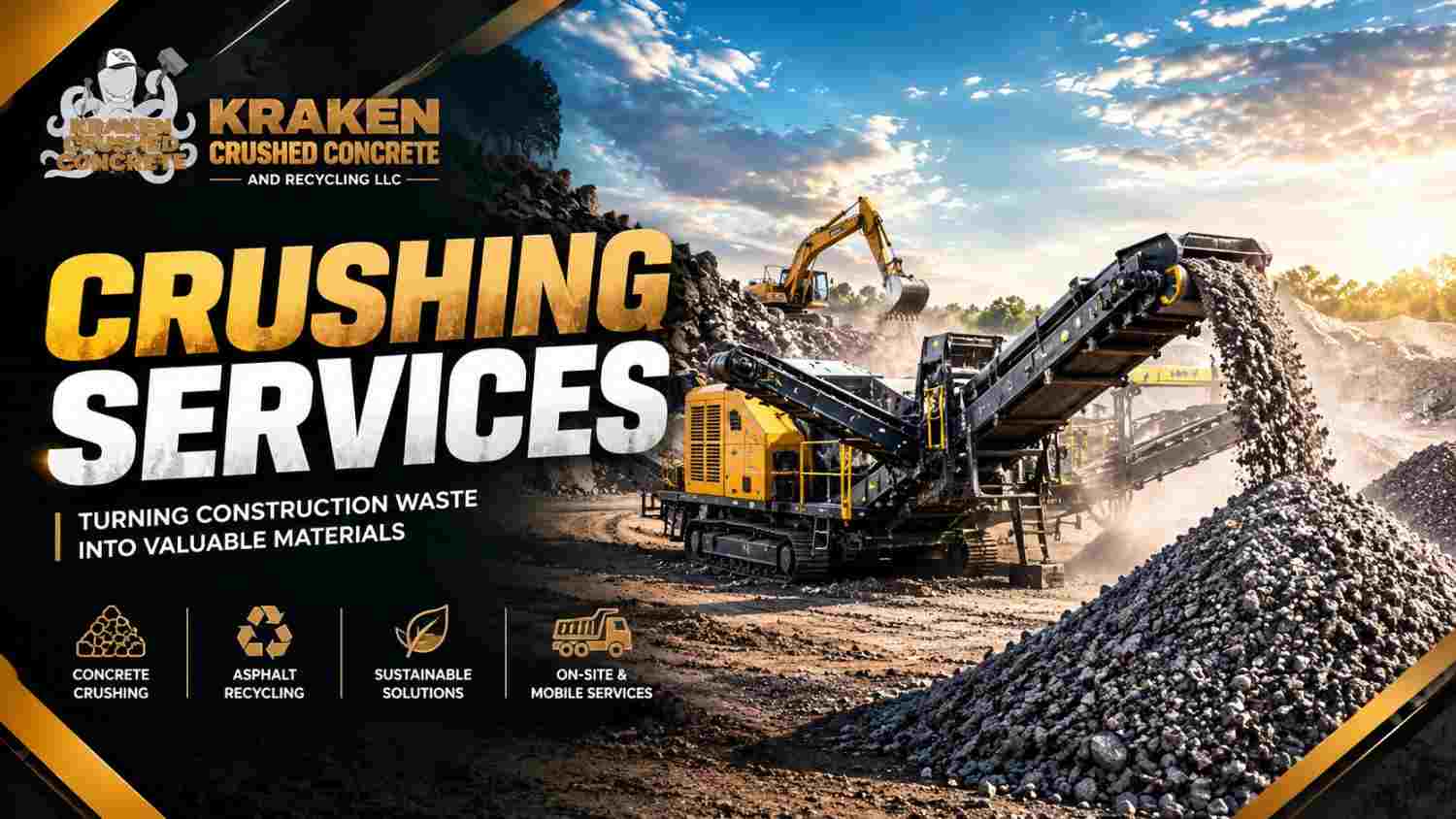
A mobile crusher can be brought to the project location, where suitable concrete is reduced into smaller aggregate material.
The finished material can then potentially be used for applications such as:
- Site bases
- Driveway bases
- Road construction
- Temporary access roads
- Backfill applications
- Construction pads
- Other suitable aggregate needs
The exact use depends on the material produced and the specifications of the project.
The important point is that material that might otherwise become a disposal expense can potentially become a useful resource.
That changes the financial calculation considerably.
Where Contractors Can Save Money
The biggest advantage of an on site crushing construction service is often the reduction in material transportation.
Suppose a demolition project produces a substantial amount of concrete. Without crushing at the property, contractors may need multiple truckloads to remove it.
Every additional trip means another transportation cost.
With mobile crushing, much of that material can be processed where it already sits.
That can reduce the number of trips required to move concrete away from the property. Depending on the project, it can also reduce disposal costs and create aggregate that can be reused on site.
The savings are not identical for every project, but the potential becomes more significant as the volume of concrete increases.
Trucking Costs Can Change the Equation
Michigan construction projects can cover considerable distances, particularly when materials have to be transported between job sites and recycling or disposal facilities.
Fuel prices, driver availability, traffic and equipment utilisation all affect hauling costs.
Consider a contractor with a large concrete demolition project.
If the material needs to travel a long distance, the contractor is essentially paying to move something that may have value as aggregate.
That is an important distinction.
When the project can use the crushed concrete on site, processing it locally may eliminate part of that transportation cycle.
Instead of:
Demolish → Load → Haul → Pay to process or dispose → Buy aggregate
the project may be able to follow a simpler route:
Demolish → Crush → Reuse
That does not mean the second option is automatically cheaper. It means it deserves to be included in the cost comparison.
What About the Cost of Crushing?
This is where contractors need to be realistic.
Crushing services are not free, and bringing mobile crushing equipment to a project involves its own costs.
The comparison should therefore never be based on crushing price versus disposal price alone.
A better calculation considers the entire project.
Look at:
Total hauling cost + disposal fees + replacement aggregate + truck waiting time
and compare that with:
Crushing service cost + material handling + any required additional aggregate
Once all of those numbers are on the table, the better option often becomes much clearer.
For large volumes, the economics can favour crushing because fewer loads may need to leave the site and usable material may remain available for the project.
The Value of Reusing Concrete
There is another financial benefit that is easy to overlook.
If suitable crushed concrete can be reused on the same project, the contractor may reduce the amount of new aggregate that needs to be purchased and transported to the site.
That creates a double opportunity.
You may spend less money getting rid of the old concrete while also reducing the need to bring in new material.
Of course, recycled aggregate must be suitable for the intended application. Project specifications, material quality and local requirements should always be considered before deciding how crushed material will be used.
Still, the possibility of turning demolition material into a usable construction resource is one of the strongest reasons contractors investigate on site crushing.
When Does Mobile Crushing Make the Most Sense?
Not every construction project is a perfect candidate.
On-site crushing tends to become more attractive when there is a significant quantity of concrete to process.
It may also make sense when:
- The disposal facility is far from the project
- Trucking costs are high
- Large quantities of concrete are being demolished
- The project has adequate space for crushing operations
- Crushed material can be reused
- The construction schedule would benefit from fewer hauling trips
- The contractor wants to reduce material handling
- Aggregate is already needed elsewhere on the property
The larger the concrete volume, the more worthwhile it can be to investigate the numbers.
A small residential demolition may not produce enough material to justify bringing in crushing equipment. A large commercial demolition, road project or industrial site can be a completely different story.
Michigan Contractors Are Also Looking at Jobsite Efficiency
Cost is important, but it is not the only consideration.
Construction managers know that time has a price.
A jobsite with a large concrete pile waiting for removal takes up valuable space. Trucks need to enter and leave the property. Crews may need to coordinate loading operations. Delays can affect several other parts of the project.
Mobile crushing can simplify some of those logistics by processing material where the work is taking place.
Fewer truck movements can mean less coordination.
Less material leaving the site can mean fewer trips to schedule.
And having processed aggregate available on the property can give contractors another option when planning subsequent site work.
That kind of flexibility can be valuable on a busy construction project.
What Should Contractors Ask Before Choosing?
Before booking crushing equipment or arranging dozens of hauling trips, take a closer look at the project.
Start with the concrete volume.
How many tons are you expecting to remove?
Next, determine where the material would go if you chose hauling.
How far away is the facility?
Then calculate the likely number of truckloads and the cost of each trip.
Do not forget disposal or processing fees.
After that, consider what the project needs.
Will you need aggregate for a road base, construction pad or another suitable application? If so, could properly processed concrete potentially satisfy part of that requirement?
Finally, look at the jobsite itself.
Is there enough room for crushing operations? Can equipment access the area easily? Are there project-specific restrictions that need to be addressed?
These questions provide a much more accurate picture than simply asking, “What is cheaper, crushing or hauling?”
Why Contractors Should Get the Numbers Before Deciding
Every construction project has its own variables.
That is why smart contractors compare actual project costs rather than relying on assumptions.
A contractor working on a site close to a recycling facility with a small quantity of concrete may find hauling perfectly reasonable.
Another contractor with a major demolition project, limited truck availability and a large amount of reusable concrete may discover that mobile crushing offers considerably better value.
The difference can come down to logistics.
It is not unusual for transportation to become expensive when material has to make repeated journeys. If that material can instead be processed close to where it was generated, the project may avoid some of those unnecessary movements.
Choosing the Right Crushing Partner
Once you determine that crushing could make financial sense, the next decision is who will handle the work.
Look for a provider with experience working on construction and demolition sites rather than treating crushing as a one-size-fits-all service.
Ask about equipment, material handling, project access, expected production and the type of aggregate the crushing process can produce.
A reliable provider should also be willing to understand your project before quoting the work.
For Michigan contractors looking for Mobile On-Site Crushing Services in Michigan, choosing a company that understands the practical realities of construction sites can make the process much easier.
The right service is not simply about putting a crusher on your property. It is about fitting the crushing operation into the project’s schedule, space, material requirements and budget.
So, Which Option Saves Michigan Contractors More?
There is no universal answer.
For some jobs, hauling concrete away will still be the most practical choice.
For larger projects, however, an on site crushing construction service can offer a compelling financial alternative by reducing hauling requirements, limiting material disposal and potentially producing aggregate that can be reused.
The key is to calculate the complete cost rather than comparing a single crushing quote with a disposal fee.
Look at trucks, fuel, labour, disposal charges, replacement aggregate, travel distance and project delays.
Then ask one simple question:
Does it make sense to pay to transport material away when the project may be able to process and reuse it right here?
For many Michigan construction and demolition projects, that question can uncover significant savings.
If you regularly handle concrete demolition, roadwork, commercial construction or large-scale site development, it is worth pricing both options before the project begins.
The cheapest solution is not always the one with the lowest initial quote. Sometimes, it is the solution that removes several expenses from the project at the same time.
That is precisely why more contractors are taking a closer look at on site crushing and the role it can play in smarter material management.
Before sending your next mountain of concrete down the road, run the numbers. The material sitting on your jobsite may be worth more than you think.
FAQs
- Is on-site crushing cheaper than hauling concrete away?
It can be, particularly on projects involving large quantities of concrete, long hauling distances and high disposal costs. Contractors should compare the complete cost of crushing, hauling, disposal and replacement aggregate.
- What is an on-site crushing construction service?
An on-site crushing construction service brings mobile crushing equipment to a construction or demolition site to process suitable concrete and other materials directly at the property.
- Can crushed concrete be reused on the same construction site?
Yes, depending on material quality, project specifications and the intended application. Crushed concrete may be suitable for certain bases, access roads, backfill and other aggregate applications.
- When does mobile on-site crushing in Michigan make the most sense?
It can be particularly useful for projects with substantial concrete volumes, high transportation costs, limited truck availability or a need for aggregate elsewhere on the property.
- What costs should Michigan contractors compare before choosing a crushing service?
Consider crushing fees, truck hire, fuel, driver costs, disposal or recycling fees, travel distance, material handling, replacement aggregate and potential scheduling delays. Comparing the complete project cost provides a more accurate answer.