Road construction is expensive for a reason. Contractors have to account for materials, equipment, labour, transportation, disposal, fuel, project timelines, and plenty of unexpected costs along the way. When prices rise or a project falls behind schedule, profit margins can disappear quickly. That is why more contractors, municipalities, and construction companies are paying closer attention to asphalt recycling solutions.
Recycling asphalt is not simply about finding a use for old pavement. Done correctly, it can become a practical way to control material costs, reduce hauling requirements, minimise waste, and keep valuable aggregate in circulation. Most importantly, recycled asphalt can still deliver the performance expected from a properly designed and constructed road.
For contractors looking for ways to work smarter without cutting corners, asphalt recycling deserves serious consideration.
Why Road Construction Costs Add Up So Quickly
A road project involves much more than laying fresh asphalt.
Before new pavement reaches the job site, raw materials have to be sourced, processed, transported, and prepared. If existing pavement needs to be removed, contractors may also need to pay for milling, loading, trucking, and disposal.
Then comes the cost of bringing new aggregate and asphalt materials to the site.
Transportation alone can become a significant expense, especially when a project is located far from material suppliers or disposal facilities. Every additional truck trip adds fuel consumption, labour hours, equipment wear, and scheduling pressure.
Traditional approaches can therefore create a cycle of:
- Removing old pavement
- Transporting waste away
- Purchasing new materials
- Transporting those materials back
- Processing and placing the new pavement
Asphalt recycling solutions can shorten that cycle by giving contractors a way to reuse materials that are already available from the existing roadway.
What Are Asphalt Recycling Solutions?
Asphalt recycling refers to processes that recover usable material from existing asphalt pavement and prepare it for reuse.
Old pavement is commonly milled or removed before being processed. The resulting reclaimed asphalt pavement, often called RAP, contains aggregates and asphalt binder that can potentially be incorporated into new pavement or used in other construction applications.
The exact recycling approach depends on the project.
Some projects use recycled asphalt as an ingredient in new asphalt mixtures. Others may involve crushing and processing material for use as a base or sub-base. Certain road rehabilitation methods can also recycle pavement in place, reducing the need to remove and haul large quantities of material.
The important point is that old pavement does not automatically become useless waste once it is removed from the road.
With the right processing, it can become a valuable construction resource.
Lower Material Costs Without Cutting Quality
One of the biggest advantages of recycling is the opportunity to reduce reliance on virgin materials.
Virgin aggregate has to be extracted, processed, transported, and prepared before it can be used. Reclaimed material has already gone through much of its original lifecycle.
Using recycled material where appropriate can reduce the amount of newly sourced aggregate required for a project. For contractors working on large roadways, parking areas, commercial developments, or municipal projects, even a modest reduction in virgin material requirements can have a meaningful effect on the overall budget.
That does not mean quality should be compromised.
Good recycling practices involve proper processing, material testing, mix design, and project-specific specifications. Recycled asphalt should not simply be added without considering its characteristics and the requirements of the finished pavement.
When the material is processed and used correctly, recycling can provide cost savings while still supporting the structural and performance requirements of the project.
Less Hauling Means Lower Transportation Expenses
Ask any contractor where money disappears on a large project and transportation will often be part of the conversation.
Moving heavy construction materials takes trucks, drivers, fuel, and time. If old asphalt must be hauled away while new aggregate is hauled in, the number of vehicle movements can increase quickly.
This is one area where asphalt recycling solutions can make a noticeable difference.
When reclaimed material can be processed closer to where it will be reused, contractors may reduce the distance materials need to travel. Fewer haul trips can mean lower fuel consumption and reduced transportation costs.
There is another benefit that is easy to overlook: scheduling.
A project that depends heavily on outside material deliveries is exposed to traffic delays, supplier availability, loading schedules, and other logistical issues. Having a reliable recycling and crushing operation available can give contractors greater control over their material supply.
That can be valuable when deadlines are tight.
Recycling Can Reduce Disposal Costs
Old pavement has to go somewhere if it is not reused.
Disposal fees vary depending on the location, material, and facility, but removing large quantities of asphalt can become expensive. Contractors also have to consider the cost of loading, transporting, and handling the material.
Recycling changes the equation.
Instead of treating removed pavement solely as waste, contractors can look at it as a potential input for another stage of construction.
This approach is particularly useful on projects where substantial quantities of old pavement are being removed. Rather than paying to transport all of that material away, a portion may be processed for reuse, depending on project specifications and material quality.
The result can be less waste leaving the job site and fewer disposal-related expenses.
What About Concrete and Asphalt Recycling?
Road construction projects do not always involve asphalt alone.
Concrete may be removed during roadway reconstruction, demolition, parking lot replacement, curb work, bridge approaches, and other infrastructure projects. That creates another opportunity for material recovery.
Concrete asphalt recycling brings attention to the broader practice of processing construction materials so they can remain useful instead of immediately becoming waste.
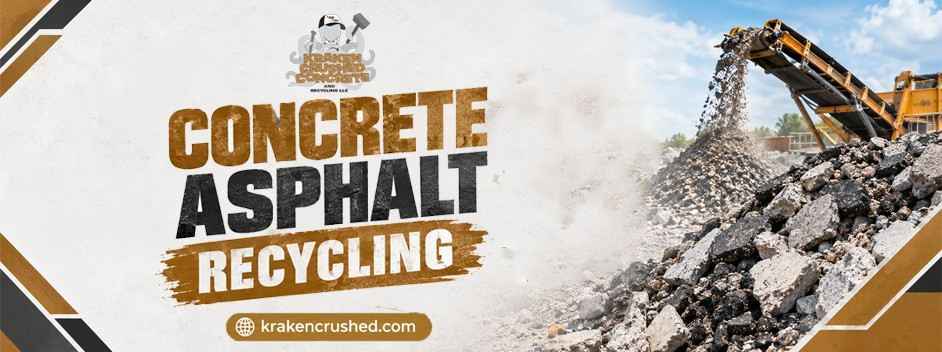
Concrete can be crushed into different sizes and used in applications such as aggregate base, fill, or other approved construction uses. Asphalt can similarly be processed for reuse depending on its composition and the intended application.
For contractors handling mixed construction materials, having access to appropriate processing capabilities can simplify material management and reduce the volume of waste that needs to leave the site.
How Crushing Supports More Efficient Recycling
Crushing plays an important role in turning recovered construction material into something useful.
When old concrete or asphalt is processed through suitable crushing equipment, large pieces can be reduced into more manageable and consistent sizes. Depending on the equipment and project requirements, material can then be screened or further processed to meet a particular specification.
This is where crushing concrete recycling becomes valuable.
Rather than purchasing all-new aggregate for every application, contractors may be able to reuse processed material generated by their own projects or sourced from suitable demolition and construction materials.
The financial benefit depends on factors such as material quantity, transportation distance, processing costs, specifications, and local material prices. However, the basic principle is straightforward: recovering usable material can reduce the need to continuously buy and dispose of materials.
Recycling Can Help Contractors Work Faster
Cost is not always measured in dollars per ton.
Time has a price too.
When crews are waiting for material deliveries or trucks to arrive and leave the site, productivity can suffer. Delays can push equipment rentals, labour costs, and project schedules in the wrong direction.
A well-planned recycling operation can help streamline material handling.
For example, if suitable reclaimed material can be processed near the project and reused within the construction process, there may be less dependence on long-distance hauling. Material can move through the project more efficiently, allowing crews to spend more time on productive work.
For contractors working under strict completion deadlines, that efficiency can be just as important as the direct material savings.
Does Recycled Asphalt Perform as Well as New Material?
This is one of the first questions many project owners ask, and it is a reasonable one.
Recycling should never mean using material simply because it is available. The quality and intended use of the recycled material matter.
Proper testing, processing, mix design, and quality control are essential. Contractors should work according to applicable project specifications and determine whether recovered material is appropriate for the intended application.
When those steps are followed, recycled asphalt can be incorporated into pavement systems without treating sustainability as a substitute for performance.
In other words, recycling is not about choosing between cost and quality.
It is about finding ways to achieve both.
The Environmental Benefit Can Strengthen a Project’s Value
Lower construction costs are important, but there is another reason recycling has become increasingly relevant.
Road construction consumes significant quantities of natural resources. Recycling helps keep useful materials in circulation and can reduce the demand for some virgin resources.
It can also reduce the amount of construction material sent to disposal facilities.
For businesses working with municipalities, developers, commercial property owners, or environmentally conscious clients, responsible material management can strengthen the overall value proposition of a project.
It demonstrates that efficiency does not have to come at the expense of environmental responsibility.
Choosing the Right Recycling Partner Matters
Not every recycling project is the same.
The right solution depends on the material available, project size, desired end use, local requirements, transportation distances, and quality specifications.
That makes the choice of recycling partner important.
A capable recycling provider should understand material processing, crushing requirements, project logistics, and the practical needs of contractors. The goal should not simply be to process as much material as possible. It should be to produce a useful material that fits the needs of the project.
For contractors in need of dependable material processing, working with an experienced provider can make the entire process easier to manage.
Kraken Crushed Concrete helps contractors make better use of recovered construction materials through practical crushing and recycling solutions. If you are looking for Best concrete and asphalt recycling Services, choosing a provider that understands both material recovery and project efficiency can help you get more value from every load.
Is Asphalt Recycling Right for Your Next Project?
The answer depends on the project, but it is worth investigating before automatically choosing the traditional remove-and-replace approach.
Consider the amount of existing asphalt or concrete involved. Look at your current hauling distances. Calculate disposal costs. Compare the price of virgin aggregate with the cost of processing suitable recovered material.
Then consider the value of keeping material closer to the project.
In many cases, the savings come from several areas at once rather than one dramatic reduction. Lower disposal costs, fewer haul trips, reduced virgin material purchases, improved material availability, and better site logistics can collectively make a significant difference.
That is where recycling becomes more than an environmental initiative. It becomes a business decision.
Build Smarter by Reusing What You Already Have
Road construction will always require investment, but contractors do not have to accept unnecessary costs as part of the process.
Existing pavement can contain valuable aggregate. Concrete from demolition can have another useful life. Materials that once looked like waste can become resources when they are properly processed and matched to the right application.
Modern asphalt recycling solutions give contractors another option for controlling project expenses while maintaining attention to quality and performance.
For construction companies looking to reduce material waste, control hauling expenses, improve job-site efficiency, and make better use of recovered materials, recycling is worth putting into the project plan from the beginning.
The smartest approach is not always to bring more material in.
Sometimes, it starts with looking at what is already there.
FAQs
- What are asphalt recycling solutions?
Asphalt recycling solutions involve recovering, processing, and reusing existing asphalt materials in new construction or road rehabilitation projects. Depending on the project, recycled asphalt can be incorporated into new pavement mixtures or processed for use in base and other approved applications.
- Can asphalt recycling reduce road construction costs?
Yes. Recycling can reduce expenses associated with virgin aggregate purchases, material transportation, disposal, fuel, and hauling. The actual savings depend on project size, material quality, transportation distances, processing requirements, and local costs.
- Does recycled asphalt compromise pavement quality?
Not necessarily. Properly processed recycled asphalt can be used without sacrificing project performance when appropriate testing, mix design, quality control, and applicable construction specifications are followed.
- What is the difference between asphalt recycling and concrete recycling?
Asphalt recycling focuses on recovering and processing existing asphalt pavement, while concrete recycling involves crushing and processing demolished concrete. Both approaches can turn recovered construction materials into useful aggregate for suitable applications.
- Why should contractors consider crushing and recycling concrete and asphalt?
Crushing and recycling can reduce the amount of material sent to disposal facilities while creating usable aggregate. It can also reduce hauling requirements and dependence on newly sourced materials, potentially making construction projects more efficient and cost-effective.